Bridge Nodes Depend on Archival gRPC — Key Findings and How We’re Supporting the Network
Bridge Nodes Depend on Archival gRPC — Our Findings and How We Are Supporting the Network
TL;DR
-
Only a very small number of gRPC endpoints currently provide true archival history from block 1.
-
Bridge nodes can sync from pruned endpoints during normal operation — but cannot fully recover from them after crashes or corrupted disks.
-
This creates a bridge-recovery bottleneck, with most operators relying on a tiny set of archival sources.
-
We now run multiple archival gRPC nodes and publish bridge snapshots to help strengthen the network.
-
More community-run archival endpoints would significantly improve overall resilience.
In short: lots of pruned endpoints — almost no real escape paths for rebuilding a broken bridge node.
Hi everyone  ,
,
with the Mainnet Beta upgrade around the corner, we want to share some insights from a technical analysis we conducted on archival infrastructure — and how we are contributing to a more resilient network.
This post is meant to provide transparent value to node operators, regardless of delegation outcomes. We believe shared infrastructure strengthens the entire Celestia ecosystem.
What We Investigated
Over the past weeks, we analyzed the availability and reliability of archival gRPC endpoints by:
-
Scraping RPC & gRPC endpoints from the Cosmos Chain Registry
-
Automatically verifying:
-
Live RPC endpoints
-
Live gRPC endpoints
-
Which gRPC endpoints expose full block history starting at block 1
-
-
Checking block-height consistency across providers
-
Identifying nodes suitable for bridge node syncing
 Key Finding
Only a very small number of public endpoints currently provide all of the following at the same time:
-
gRPC enabled
-
Full archival history (from block 1)
-
Up-to-date block height
For day-to-day operation, bridge nodes can sync from pruned gRPC endpoints as long as those endpoints stay online and keep enough recent history.
However, this becomes a problem in recovery scenarios – for example:
-
a bridge node crashes and needs to be rebuilt from scratch
-
a disk is corrupted
-
a major upgrade goes wrong and you have to wipe and resync
In these cases, a bridge can only fully recover if there is either:
-
a recent, trusted snapshot, or
-
a truly archival gRPC / RPC endpoint that still serves data from block 1.
Our measurements show that the network currently depends on very few such archival gRPC sources that can be used as full recovery paths for bridge nodes.
This concentrates risk: if those few archival providers are unavailable or fall behind, operators may face slow, fragile, or even blocked recovery options for their bridge nodes.
In short:
The network operates with plenty of pruned endpoints but almost no true escape paths for rebuilding a broken bridge node.
 Why Archival gRPC Matters for Bridge Nodes
Bridge nodes rely on archival gRPC to:
-
Reconstruct namespace Merkle trees
-
Perform Data Availability Sampling (DAS)
-
Verify historical headers and data-availability proofs back to genesis
-
Avoid relying on pruned nodes, which cannot serve historical proofs
A lack of reliable archival endpoints means:
-
Slower recovery (if recovery is even possible)
-
Higher sync fragility
-
Increased load on the few existing archival providers
 What We Are Doing to Help
 Bridge Node Snapshots
We will maintain up-to-date bridge snapshots, enabling operators to:
-
Start a fully-synced bridge node
-
Skip long initial sync periods
-
Recover quickly after upgrades
-
Reduce load on limited archival gRPC endpoints
 Full Archival Consensus Nodes With Open gRPC
We have started to operate several independent full archival nodes, providing:
-
Public gRPC endpoints
-
Full block history from block 1
-
High uptime monitoring
-
Upgrade-ready infrastructure and continuous monitoring
These nodes are intended as reliable fallback sources for bridge nodes, especially during upgrade windows.
 Call for Community Collaboration
We encourage operators and validators with capacity to:
-
Run at least one archival consensus node
-
Expose gRPC publicly
-
Announce availability to the community
Even a small increase in archival providers significantly improves overall network reliability.
If you are running an archival node and want it included in our monitoring set, feel free to reach out.
 Technical
We also built a global RPC benchmarking and gRPC archival-detection system [1] that measures endpoints from multiple Cloudflare POPs worldwide and checks:
-
Latency
-
HTTP health
-
Block height
-
Archival depth (via gRPC Block 1 check)
-
“Latest height” status (with ±5 block tolerance window)
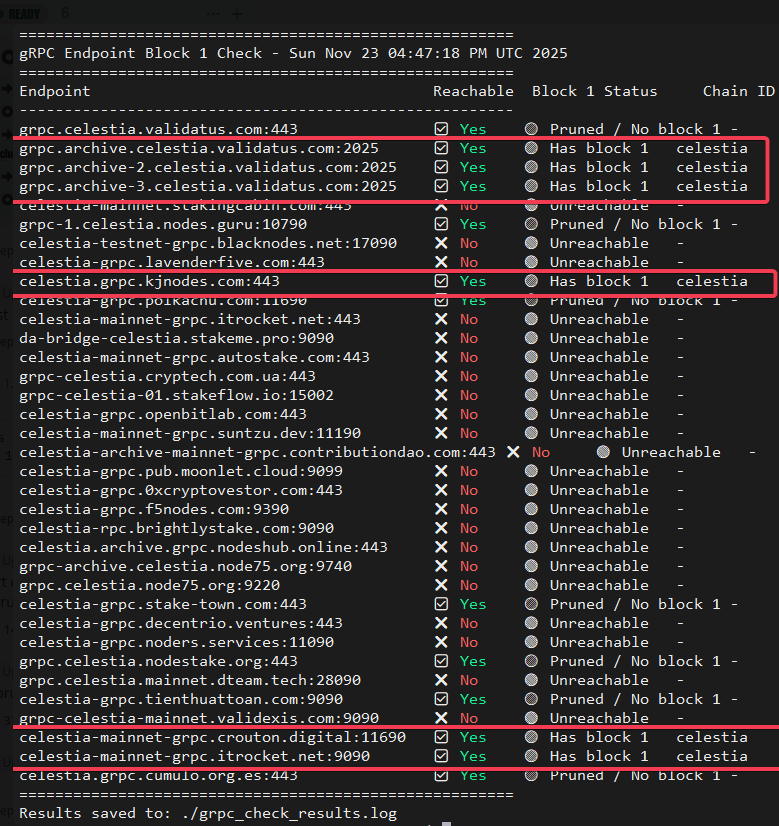
The screenshot below shows a sample run of our gRPC endpoint check tool against Celestia endpoints. This is CLI output from our probe — the dashboard UI will be shared soon.
[1]: gRPC Endpoint Check (Archival Detection) — sample CLI output from our probe
Operators interested in performance benchmarking or adding their endpoints to our public metrics are welcome to connect.
We’ll share the dashboard URL very soon!
 Questions to the Community
We’d love to hear your insights:
-
Are you running a full archival node with gRPC enabled?
Would you be open to listing it as a sync source for bridge nodes?
-
Have you experienced bridge-sync issues during previous upgrades?
-
Would a shared list of vetted archival gRPC nodes be useful to operators?
-
Should Celestia consider publishing a recommended minimum set of archival nodes?
-
Is anyone working on tooling for automatic fallback between archival RPC sources?
Thanks for reading — and for helping strengthen the Celestia network.
We welcome collaboration and discussion.
— Validatus Team

